The Nottinghamshire Battlefield: The Battle of Stoke Field 1487
- Posted in:
- Heritage
The Battle of Bosworth in Leicestershire in 1485 altered the course of English history and ushered in the reign of the Tudor dynasty. It was regarded as a significant win for the House of Lancaster during the War of the Roses, a war that had seen the House of York and the House of Lancaster fighting for the English throne since 1455. In this battle, Henry Tudor’s (subsequently known as Henry VII) army managed to kill the current king Richard III on the battlefield, allowing Henry and the House of Lancaster to take the throne.
Today, this battle is largely considered to have ended to the War of the Roses as the Tudor dynasty managed to consolidate and maintain power until Elizabeth I’s death in 1603. But at the time, the Yorkists weren’t ready to give up and were making moves to secure the English throne once again.
The Yorkist side found hope in Lambert Simnel, a 10-year-old boy pretending to be the Earl of Warwick, supposedly the son of Edward IV’s brother. The leaders of the Yorkist side used Simnel to re-group support after the devasting Battle of Bosworth.
To gather an army, the Yorkist leaders travelled to Dublin in May 1487 and managed to recruit over 4000 men. Simnel was even crowned ‘King Edward VI’ in Dublin by the Yorkist leaders and Irish nobility.
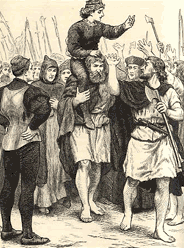
Above: 19th century illustration depicting Irish supporters carrying Simnel (By Encyclopedia Britannica, 11th Ed. Vol XXV. Cambridge: Cambridge University Press, 1910. 124. - Encyclopedia Britannica, 11th Ed. Vol XXV. Cambridge: Cambridge University Press, 1910. 124., Public Domain)
Returning to England at the start of June 1487, the army numbers increased to around 8,000 soldiers and the men began travelling south from Lancaster. Along the way, the rebel Yorkist army encountered Lancastrian cavalry which started three days of skirmishes at Sherwood Forest. The Lancastrian cavalry was forced back to Nottingham by the rebel Yorkists, and there the cavalry waited for Henry’s main army to come and assist.
King Henry’s army of some 15,000 men arrived in Nottingham on 14th June, including reinforcements from Wales. The poorly-equipped Yorkist army were dangerously outnumbered.
Both sides clashed in battle on 16th June 1487 in East Stoke, a battle to be known as the Battle of Stoke Field. It remains Nottinghamshire’s only registered battlefield.
Only parts of Henry’s army had formed up properly when the battle started but even so, the Yorkist army, with their fewer numbers, poorly-equipped soldiers and weaker leadership, suffered a devasting loss with heavy casualties. By the end, almost all of the Yorkist leaders had been killed and many of the soldiers tried to ‘flee towards the River Trent but were captured or killed. The River Trent is said to have “run red with blood”’.
The number of men killed in the battle is estimated to be between 4000-7000 men and unfortunately the hope of putting a Yorkist on the throne died with them.
Burial pits containing some of the fallen have been recorded near East Stoke (M1680 and M17856). A small number of 8-11 individuals recovered from this pit were analysed as recently as the mid 2010’s. The results suggested all the remains belonged to robust males aged between 17 and 46. Sharp force trauma was encountered on many bones including skulls and tibia. Some of the skulls recovered from one of the burial pits, illustrating battlefield trauma, are on display currently at the National Civil War Centre in Newark.
Dr Samantha Tipper at Anglia Ruskin University is also currently undertaking osteoarchaeological analysis on a set of skeletons recovered from the battlefield and it is hoped that from this project we can find out more about a bit about who these soldiers were, what they experienced during their lives, and where they spent most of their lives.
The Battle of Stoke Field is not only important for Nottinghamshire’s heritage but also in English history as the true end of the War of the Roses.
For fantastic videos, including some wonderful interviews with some of the main characters of the battle, and a self-guided trail on public footpaths to visit the site, visit the Nottinghamshire County Council’s web page here.
As a registered battlefield, Historic England manages the record and research of this site, you can view their list entry here.
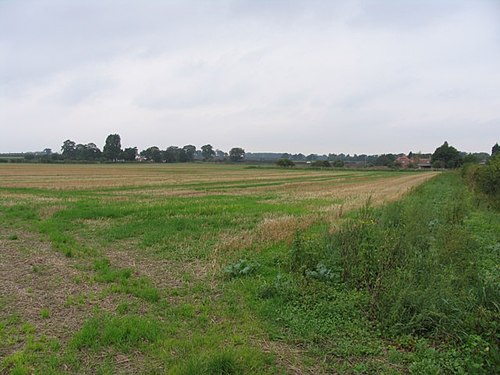
Above: Battle of Stoke Field at ground level (By Andrew Tatlow, CC BY-SA 2.0)