April 2026 Nottinghamshire Heritage Events
- Posted in:
- GetInvolved
April is bursting to the seams with exciting heritage events. There's something for all ages and interests, check out just a few of them below:
Opening Wednesday 1st April: A new exhibition ‘We The People’ is to open at Lakeside Arts. ‘Drawing on a wide range of manuscripts and printed collections, this exhibition commemorates the 250th anniversary of the American Declaration of Independence. It explores the issues at stake in the Wars of Independence and considers some of the complex problems which faced the United States as it fought to win, and realise, its new-found freedom’. This exhibition is free and booking is not required. If you don’t have time to visit this April, don’t worry as this exhibition is open until September. For more information, visit the event page here.
Thursday 2nd April: Join buildings archaeologist James Wright for the online talk ‘The Folklore of Ancient Buildings’. ‘This talk will attempt to decipher the complex relationships between archaeology, folklore, and architecture’. Tickets are acquired through donation and booking is required. Book your place here.
Sunday 5th and Monday 6th April: Papplewick Pumping Station’s ‘ever popular Easter steaming returns’ this April. The event features something for everyone including live music, trade stalls, live entertainment by The Grand Cavalcade, a multitude of historic displays and demonstrations, and lots of refreshments. Tickets cost up to £14.50 per person (under 12’s go free) and booking is not required – booking on the door is available but tickets are 50p more expensive. Book your place here.
Wednesday 15th April: Join Nottinghamshire County Council’s wonderful planning archaeology Emily Gillott at Worksop Library to explore recent archaeological discoveries form Nottinghamshire. She will ‘present stories of recent discoveries on subjects ranging from cremation and burials to Roman villas and pottery, ritual landscapes in Skegby, charcoal burning in Sherwood Forest, and more’! Tickets cost £3.50 each and booking is required. Emily’s last presentation sold out quickly so don’t hesitate to book your place here.
Friday 17th April: In association with the National Civil War Centre, ‘Dr Samantha Tipper, Senior Lecturer at Anglia Ruskin will share her fascinating analysis of human skeletons from the Battle of Stoke Field and the stories hidden in their bones’ at the Palace Theatre, Newark. Tickets for ‘Evening Talk: Silent Witnesses: What human remains tell us about the Battle of Stoke Field’ cost up to £10 per person and booking is required. Book your place here.
Saturday 18th April: Head to Bassetlaw Museum for a presentation on the story of cinema in Worksop by projectionist Derek Taylor. Derek, the last projectionist at The Regal Cinema and Theatre before its closure in 2005, reflects on his years behind the projector and backstage. Derek not only made up and shown the films, but also worked with a whole variety of acts from school and amateur productions to world famous stars. In this engaging and nostalgic talk, he explores Worksop’s picture houses from their 19th-century beginnings through the Regal’s long history to the modern revival with the Savoy’. Tickets are free (suggested donation of £3) and booking is required. Limited tickets remain so book your place here.
Tuesday 21st April: At Mansfield Central Library, ‘Joy Wood will be talking about the history of Harlow Wood orthopaedic hospital near Mansfield, and her time there during her nurse training from 1977 – 1979’. Tickets to ‘Heritage Talk: From Bedpan to Pen!’ cost £3.50 per person and booking is required. Book your place here.
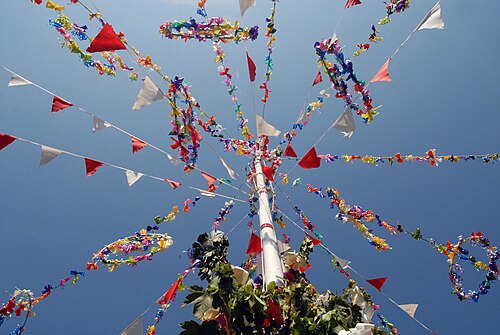
Above: May Day flagpole (By Bryan Ledgard - Flickr, CC BY 2.0)
Monday 27th April: In association with Creswell Crags, ‘join folklore expert, Icy Sedgwick, online to discover the fascinating folklore of May Day’. ‘Both one of the pagan fire festivals and a beloved fixture in the folk calendar, May Day is a popular celebration of the start of summer. It offers a host of rituals, fertility practices, good luck charms, and love divination. This talk will explore some of the customs associated with May Day in the UK’. Tickets are free (suggested donation of £4) but booking is required. Book your place here.
Tuesday 28th April: At West Bridgford Library, Sam Millard will be presenting the ‘Heritage Talk: Reason and Rhyme’. ‘The original reason for the rhymes has, by and large, been completely lost and forgotten. 'Reason and Rhyme’… looks at the original meaning of rhymes and how they have been recorded over time’. Tickets cost £3.50 per person and booking is required. Book your place here.
Thursday 30th April: At Retford Library, ‘historian Robert Mee examines the origin of almshouses in the Byzantine era, their development during the Medieval period and their continuation into modern times. He will look at the 30 or 40 almshouses closest to Retford, some of which are still in use today’. Tickets cost £3.50 per person and booking is required. Book your place here.
Thursday 30th April: ‘Located at Yew Tree Farm in Bonsall, Derbyshire, is a Grade II listed framework knitters’ workshop built in 1737 and left largely untouched since one of the last local knitters passed away in 1911. Behind the characteristic wide knitters’ windows, traces of the trade are still preserved including spare frame parts and written notes on the walls. This free lunchtime talk, delivered by the current owners, Adam Hill and Samantha Deakin Hill, outlines the history of the workshop as well as the current conservation project, funded by the National Lottery Heritage Fund and the Historic Houses Foundation’. This talk at the Framework Knitters Museum is free but booking is required. Book your place here.